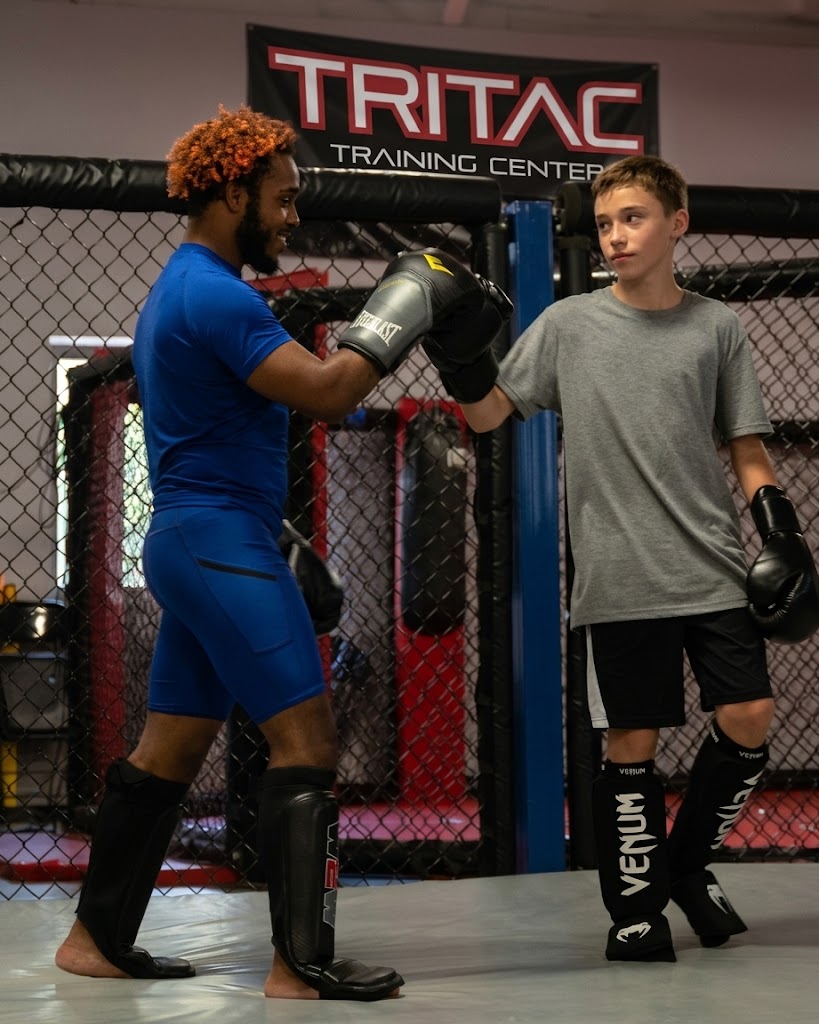
Teenagers know when something has been watered down for them.
A 15-year-old doesn’t need cartoon martial arts. They also don’t need to get dropped into an adult fight class and told to keep up. They need real training with coaching that matches where they are.
At TRITAC, teens can train martial arts, grappling, striking, self-defense and strength. They work with peers. They learn from the adult classes. And as they earn more responsibility, they get more access to the same training pathways our adult members use.
Teens do better when somebody notices their effort, sees when they are struggling and knows when to push.
They learn actual martial arts: Jiu-Jitsu, wrestling, striking, clinch work, self-defense and live partner training.
Age-appropriate strength coaching teaches movement, technique, consistency and how to train a growing body intelligently.
The adult coaching staff is involved in the teen program.
Teenagers aren’t handed off to a random assistant and forgotten. The coaches who teach the adult classes are the coaches who teach the teens.
Owner and head coach. 35 years on the mat, BJJ 3rd degree black belt, Kobukai Jujitsu 5th Dan, co-creator of the TRITAC system.
Head S&C coach. NASM + ISSA certified, 12+ years training fighters and general-population clients.
Lead combatives coach. Defence Lab co-founder and KFM World Ambassador.
Coaches and manages the TRITAC jiu-jitsu team. Active competitor on the regional circuit.
Coaches judo and runs the youth program.
Martial arts found me at the right age.
“Training gave me a place where improvement made sense.”
I started martial arts around 14. I started wrestling at about the same time. I wasn’t the naturally gifted kid. I wasn’t the kid everybody expected to become good at this. But training was the one thing where getting better made sense. You showed up. You worked. You got a little better. You learned how to handle frustration. You found people who cared whether you came back tomorrow.
That is a huge part of why I care about the teen program. I don’t expect every teenager who walks in here to become a lifelong martial artist. I do want them to leave stronger, more capable and more comfortable doing hard things than when they arrived.
Three steps. Then we see how they like it.
- 01
Start 21 Days Free.
Tell us about your teen, what they’re interested in and any previous sports or martial arts experience. No card.
- 02
Meet a coach and see the gym.
We will walk you through the mat space, cage and strength area. Parents can ask questions. Teens can see the place before being expected to jump into it.
- 03
Train.
We will help place them in the right martial arts and strength sessions based on age, experience, maturity and goals. There is no need to decide their entire martial arts future on day one.
Paige started here as a teenager.
Paige Pendl first came to TRITAC at 13 to get stronger for soccer. She stayed. She trained Jiu-Jitsu. Added self-defense. Kept learning. In December 2025 she earned her Brazilian Jiu-Jitsu purple belt. She is now an adult and a working physical therapist.
That is the long version of what can happen when a teenager finds training they actually enjoy: it becomes part of who they are. Not every teen will stay fifteen years. They don’t have to.
The goal is to give them something real to work at now, and see what grows from it.
The teen program is probably a fit if...
- Is 13-17
- Wants real martial arts instead of a children’s program
- Wants to get stronger with coaching
- Is brand new and nervous about walking in
- Already plays a sport and wants better strength and movement
- Has been bullied and wants to feel more capable
- Has never found a team sport they really liked
- Wants to compete in Jiu-Jitsu, MMA or another martial art someday
- Mostly just needs a good place to train
- Your child is under 13. Ask about Youth / Family Judo.
- They have an injury or medical restriction that needs clearance.
- They are strongly opposed to contact training.
- They are being forced to attend and absolutely do not want to be there. Bring them by to meet us first, before training becomes another argument.
Parents can understand what their teen is working on.
The Training Hub gives members a place to review training between sessions. For teens, that can mean a short drill, a technique video or a clear reminder of the current focus instead of trying to remember everything from class.
- Review current training focus
- Technique videos and breakdowns
- Short drills for home
- Progress visibility
- A clearer connection between one class and the next
Questions parents ask before their teen starts.
Potentially, when a coach believes the pairing makes sense. Teen live work is supervised closely. Partners are selected based on size, experience, maturity and the goal of the round.
A teenager is not expected to “survive” adult sparring.